Showing posts with label locations. Show all posts

Tuesday, 24 May 2016

NIGHT SHOOTING : FILMING ON LOCATION AT NIGHT

Shooting at night s probably one of the toughest things you can attempt as a low budget filmmaker, this is because, no matter what you are shooting on, your camera needs a good amount of light to capture a good quality image. Shooting at night reduces your light sources drastically if you are shooting in urban areas and if you are shooting in the woods, the middle of country side or even somewhere that isn't usually accessed after dark it becomes even trickier business to get that light onto your cameras sensor.

One work around is to shoot 'Day for Night', which involves shooting the scene in sunlight (works best shooting on  cloudy/overcast day) and then grading in post to make the image look a little like twilight. I tried this early on when I started making films and really hated the results, I've always found it better to shoot in darkness and bring in whatever light I can. The result is always a far better image.

Having a budget usually solves this problem by hiring huge spotlights and generators to help make up for the lack of good light, but this is expensive and something that is usually saved for large budget productions. If you, like us, are usually make stuff on spit and buttons, then you'll need to come up with more creative solutions to work around your lack of light.

Here are 3 tips to help you get the most out of shooting at night and how to take that into account when you are looking for your location.

1. PICK YOUR LOCATION WISELY

The easiest way you can start to combat shooting at night is by picking your location wisely. A few years ago, when we were working on preproduction for Creepsville, I would wonder around at night looking for the best lit streets, alleys, carparks, you name it and once there I would look at how much light is already there from street lamps, security lights. Then I would look at what other extraneous light sources there were like shops signs, obviously the more light the better. This means less light I have to bring along with me, which in turns means less disturbing people and less drawing attention to yourself.

Legacy of Thorn (2014)
On Legacy of Thorn, when it came time to shoot the infamous 'bridge scene', I spent months looking for a bridge that we could shoot on without being disturbed that would also give us enough light to cover the action. The first one we tried, we scoped during the day, took note that it had street lights above it and figured it would give us enough light. On returning in the evening, not only did we find that most of the street lights were broken, but it was also a well known hangout for crackheads who made themselves a problem very quickly.

We eventually found something closer to home that fit perfectly and although it had some street lighting, we still had to make up the difference with our own portable flood lights.

 Get Legacy of Thorn on DVD and Digital HD now.
ADVERTISMENT

2. PORTABLE LED LIGHTS

Chances are, if you are out shooting in the woods, on the street or in an abandoned factory at night, you're not going to have access to power. This always something I try to avoid, simply to make life easier for us and give us more freedom in lighting. However, if its not possible, we bring out the portable, rechargeable LED'S. These are bright flood lights that charge on the mains and give around 3 Hours + of continuous use and weigh next to nothing. They are fairly harsh, but used correctly (with gels or diffusion) are a great way to light dim sets when there is no good natural light. They cost around £45 each when I bought them in 2013, there are now better cheaper options out there too.


Cleaver : Rise of The Killer Clown (2015)
On shooting Cleaver : Rise of The Killer Clown, we were shooting a scene in a car, in the middle of the night, in a residential area. The last thing we wanted to do was pull a generator out there, or we certainly want to run cables across the road. The street lamps gave us some coverage, but nowhere near enough once our actress was in the vehicle. In stead we matched the street light colour on LED's with gels and just used whoever was free as light stands. It matched the natural light, but it gave us the extra light we needed to make the scene more visible.

Cleaver : Rise of The Killer Clown (2015)
These lights are great in place of having to drag a noisy generator down and even then it takes an expensive generator to run even our low wattage work lights, never mind our red heads or spotlights. Using these also means that should we need to, we can use a smaller generator to run other low power things like charging stations and smoke machines.

P.S. Before I could afford my own portable LED'S I made some for about £5/$7 each, find out how HERE.

3. FAST LENSES

One the best weapons to combat low light situations is using a fast lens on your camera. This is something that wasn't even really a choice when I started out filmmaking, if your camera's fixed lens sucked in low light (which they all did) then that was that. Now even the most inexpensive DSLR'S can capture great low light images with the right lens attached,  If you're shooting on an interchange lens system camera, you should try and have at least one fast lens that opens to at least f/1.8. This will help you get more light into your camera and make picking up a usable image just that little bit easier. Its best not rely on this, but it can give you that extra boost once you've done the above. There are also cameras like the Sony A7S/A7S2/A6300 that can shoot in incredibly low light with out damaging your image, but I still advise taking location and lighting into account even with miracle cameras like that available.

When shooting the infamous 'Bridge Scene' on Legacy of Thorn, even with choosing the best location for light and having the portables there, I still ended up shooting almost every shot on my Canon 50mm f/1.8 to get a better image. The downside of this is that the depth of the image was very shallow, but the upside was that I got a better image and because we were shooting in a wide open space it meant that the close focal length didn't impact what I wanted to get too much.

These days if we're shooting outdoors I try to plan my shots around the widest opening lenses that I have. Its not always possible, but its worth thinking about.

_____________________________________________________________

MJ

IF YOU FIND THIS BLOG USEFUL. PLEASE SHARE. You can keep up to date with our filming goings on at our FACEBOOK PAGE :)

ADVERTISMENT


Tuesday, 17 May 2016

THE WAPAH!! CHECK LIST : 5 Ways to Check Your Location Has EVERYTHING You Need.


So you've found the perfect place to shoot. It has the right aesthetic for your films tone and its functionality matches your script perfectly, but there are some things that you'll want to bear in mind before you start booking your cast and crew.

Once you've found your location, we talked about some ways to do that HERE, you'll need to make sure that it suits your needs and that its a viable venue to set your movie. Not all locations are created equal and there are 5 things that you need to look at to make sure that where you want to shoot works for you. 

I created something called 'THE WAPAH!! CHECK LIST', which are 5 things that you should look at when you are scouting for places to ideally shoot your next film.

WATER
One of the first things I do is check that there is running water on location. Especially if you are going to spend any length of time there. It seems like something that wouldn't be that important, but if you don't have access to running water, trust me, you notice fast. This could just be a bathroom or kitchen and if you are shooting in a standard suburban house or commercial facility then, chances are, that they'll be water for bathrooms/washing/cleaning up/doing hair and makeup/special effects etc. 
Legacy of Thorn (2014)

However when you're out shooting in warehouses, old buildings and abandoned places (as well as out in nature) Water starts to become harder to come by. This is where you need to figure out how much water you need to bring yourself,  for people and for functionality. Drinking water should always be brought anyway (don't EVER let your cast and crew drink from taps in abandoned or old buildings), but you should be aware of how much you need and what you need it for. 

On Slasher House and Legacy of Thorn, we shot in old, non functioning government buildings. They had electricity and some running water (only cold), but there was no water flow to the showers in either case. This was a problem when most people returned from shooting each evening covered in dirt and sticky blood. Obviously before we got there we had to figure out a solution to that. Which brings us to...

AMENITIES  
Based on how much access and the type of access we have to water and facilities, I then look at the local amenities to figure out just how far we'll have to travel to do things like shower/use the bathroom/get refreshments. This should, again, give you a good idea of what you need to bring in terms of equipment, food, water and what you can have access to on the day. What shops are available locally? How far is it to get to them?

The distance between your set and your amenities can make a huge difference. If you're working with a small crew and suddenly someone you NEED has to take a 90 minute round trip to pick up food or take an actor to the bathroom or what have you then you are gonna see a lot of downtime when you're not shooting and this is when thing start to overrun and cause problems. Also, if you've every met an actor who can't shower for a couple of days, then you'll understand how important it is to find somewhere for them to wash regularly. 

On Legacy of Thorn, the school we shot in (and lived in) for 14 days, had electricity and running cold water, but then water only ran in the admin building and not to the showers down in the sports block. We bought solar showers as it was the height of summer, but they were less than successful, luckily we had scoped out the leisure centre before hand, about 20 minutes down the road and told them what we were up to, they agreed to let us use their showers and we scheduled in time in the day for actors (and then crew) to go and get washed if they needed. 

POWER
Obviously if you are shooting a movie, you are probably gonna need power. Although not in all instances, which is why its actually 3rd on the list (that and it helps me spell WAPAH by being here). After checking our water supply and amenities I look to see how much power (if any we have). How many power points are there? Are the functional? Are they wired safely? How many extensions will we need to set up how many lights? This way I can plan exactly what I need to pack in terms of power/lights and if we need a generator or not.

If we're shooting outdoors, we use rechargeable led lights and scout with that in mind to try and find places with decent natural light already, If we're shooting in the day, this becomes less of an issue obviously and its entirely possible to shoot with natural light and some reflectors. If you're shooting in doors at night you'll probably need power. This is also useful for things like recharging gear, batteries, running footage off the camera and making cups of tea (The most important use of power on a British set). 

On Slasher House 2, we needed to shoot in a graveyard, but getting power out there was a problem that we found impossible to solve. To try and regain control over lighting, we asked a lovely friend of ours who had helped us out on a previous film, if we could use there expansive garden to build a graveyard and run power from the house. The only problem is that they only had one outlet we could run power from, we thought it would be enough at a push and very quickly we started to find that we would lose power to the 3000 watts worth of lights we were running. This meant having to pause filming every 20 minutes of so in the pitch black on a -1 December evening. Make sure you have enough outlets to run your equipment properly.


ADVERTISMENT
ACCESS
What kind of access you have to your location is important and it will ultimately determine if the location is right for your shoot. Can you only get in to the location at certain times? Can you access it around the clock? Is it a 6 hour drive away from base camp? Is it near any civilisation at all? Can you drive to it or do you have walk on foot? There is a huge list of things that will make getting to a location a problem and you sometimes have to weight up if that location is worth using if its too difficult to get to.

You also want to be aware about how long you have at the location, if you need to work around a business then you will probably be shooting after hours, if you need nightfall then you'll have to check that you have access at night. Its worth checking if you can house your cast and crew there to. The easiest shoots i've had are the ones where we lived on set (or in the same complex) as there wasn't travel to worry about or driving back and forth from location every day. Plus it makes its easier for everyone to bond.

On Slasher House 2, we had our main location around the clock, which was fine as we needed to shoot at night because of the locations huge factory windows, we just couldn't cover them. This was fine as we could get in anytime we wanted, The only stipulation was that if we didn't leave by 10 when the gates closed, then we had to stay until 5 in the morning when the gates opened. This led to either having to rush through what we were doing as soon as it got dark, or finishing in the small hours in the cold and then having wait to leave. It took us a while to try and swing the right balance, so its important to try and factor these things early on if you can.

HEALTH AND SAFETY
After I've checked all the above, I then do a huge sweeping check that I consider the MOST IMPORTANT one of all. Health and Safety. This really goes to looking at most of the previous things over all, Is the power safe? Is there enough water to clean wounds? (Real ones rather than sfx) Where is the nearest hospital? The nearest first aid kit? and then I look at what has to happen in the scenes and looks at where our actors will be and how to keep them out of as much danger as possible. Looking for things like loose flooring, nails, low hanging roofs, doors, wires anything that I think might be a hazard and just look at what I need to stay away from and what I can clean up or make safe again. 

Its most important of all to keep you cast and crew safe. If they are going to be crawling around of the floor then I'll make sure its swept and that any sharp objects are removed and just generally try and make it as comfortable as possible without ruining the aesthetic. If there are any stunts, I look at how we are going to do them safely and securely and wether we'll need mats or not. A lot of it is really just common sense, like "don't touch that live wire", "Don't hold that 1000 watt light with your hands" or "don't kick this pile of asbestos boards thinking they are plaster" (That one was me on my first shoot). 

Also and this is a BIG ONE : Make sure you have Insurance, even if you are just making a little no budget movie, make sure that have insurance that covers you in case of any accidents to your actors and the public, you'll save yourself a load of problems should the worst happen. In all honesty there have been very few accidents on our sets, Thats probably down to a mixture of luck and planning, things do just happen, especially when people are in the heat of the moment during a performance and all you can do is do your best to try and account for what could go wrong. Just be careful and ask your actors and crew to do the same, but try and stay safe.


___________________________________________________________________


MJ

IF YOU FIND THIS BLOG USEFUL. PLEASE SHARE. You can keep up to date with our filming goings on at our FACEBOOK PAGE :)

 Get Legacy of Thorn on DVD and Digital HD now.
ADVERTISMENT


Tuesday, 10 May 2016

FINDING LOCATIONS : 3 Easy Ways to Find Your Next Film Set


As we've talked about before, finding the right location can make or break your movie. Shooting your film in the right place adds so much production in terms of style, look and value that to over look it is setting yourself off on the wrong foot.

In big budget movies, it not uncommon for sets to be built on a sound stage wherever possible, this is usually due to the amount of control the creative team needs over the set, i.e being able to remove walls, lighting, shooting around the clock. If you're shooting on a budget its unlikely (although not impossible) that you can build your 'Church Interior' or 'Canadian wilderness' from scratch as a set on a sound stage. This usually means that you have to find something the preexists in the world.

This is both a blessing and a curse. Finding a pre-existing location means that you have less control over things like weather, power, access, angles, food establishments and the list varies drastically from place to place, meaning a lot of prep and compromise most of the time. The upside however, is that you get something real, something that you can't build, something raw and lived in and that is really what adds the value to your films.

FINDING YOUR LOCATION

Following are 3 ways of sourcing locations when you are working on a limited budget, These 'suggestions' are by no means the best , or the only, ways of finding the right location for your film, but hopefully they'll help you think creatively about what you need and help you look at where you shoot in more productive way.

1. UNIQUE CIRCUMSTANCES

Douglas Prison : Isle of Man
Finding locations can be tough going. Especially if you need anything outside of student flat or family home, things start getting difficult pretty quickly. This is when you need to employ some of your unique circumstances to finding what you need. By 'Unique Circumstances' I mean this, Everyone has access to something unique that no body else has access to, in terms of locations.

This is basically looking at what you have access to personally. Can you make a film out that creepy looking shack your dad built at the bottom on the garden? Does your Aunt work at a High School after hours? Does your mate have the keys to the warehouse on a weekend? All these are great starting points to finding a great location to shoot in that isn't 'Mark's Studio Apartment' and also a brilliant way of getting the creative juices flowing. There a few things than coming up with a  scene or even an entire film based around an amazing location. 

I always 'try' to write locations based on something I know we have or can get access too, even if that means taking a pause from writing for a moment and throwing it out there to people I know with a "Does anyone have access to..." and usually I receive a "No, But I have access to...", sometimes this will dictate where the film is set and sometimes the direction a film will go.  You have to be creative and compromise when it comes to low budget filmmaking. 

Slasher House (2012) Douglas Prison : Isle of Man 

For Example, I originally wrote Slasher House to take place in an old run down mansion, when we were offered an abandoned prison, it was too good to pass up and we adapted and it worked out for the better, both visually and thematically. It also meant we had to adapt one scene to be set in a 'Gallows' which was a pretty awesome, if not terrifying, experience and also added another dimension to the film.

ADVERTISMENT
2. YOUR NETWORK

After you've spent your first couple of movies exhausting and exhausted your family and friends locations, you should have begun to develop a 'network' of people to work with, to show your work to and who also make movies. This is your community and these are the people you can turn to for help. 

Other filmmakers are a great conduit for resources, this is because, just like you, they spend their time making movies and, believe or not, have come up against most the same problems you have when it comes to getting locations and come out the other side. Its a great way to to find creative solutions to problems, by talking to people who have already solved those problems and getting their advice.

The biggest advantage of this, is that it gives you a new perspective and helps you think outside the box. One of the biggest mistakes I see people making in terms of locations is that they need something so they look for "INSERT LOCATION HERE" and that alone, when one of the key ways to solve the problem is finding something that can do the same job, but provides earlier access. Other filmmakers will have been through this and will be able to help advise you and what can substitute your needed set. 

Legacy of Thorn (2014) : High School Oldham : Main Building
Legacy of Thorn (2014) : High School Oldham : DT BLOCK
What I mean is, for example, on Legacy of Thorn we needed a hospital, but getting one that looked operational was tougher than we could have imagined. Instead we found a section of our old college that looked very similar to a hospital corridor (along with first aid room) and dressed it up to stand in for it. Throwing in some posters, a couple of extras in long white coats and nurses uniforms and we had a what we wanted but without the red tape of shooting a real hospital. 

Sometimes its worth talking to other filmmakers about how they made it appear that they shot in a location.

3.  JUST ASK

Possibly the simplest approach to finding the right location is to find the location you are after and just ask. It seems like there might be more to it, but its really as easy as that. Sometimes if we need a specific location we just find the place we want and then ask. Sometimes we're successful and sometimes not, but no one has ever done anything worse than say 'No'. Usually people just want you to cover electric or a small charge to use it, sometimes they might even just let you have it for free as long as it doesn't conflict with business hours etc.

The real issue with this approach is that it can become a numbers game and thats a lot of ground work, but if you're willing to put that work in, you'll almost certainly find the location that you're after. Just find the type of location you're looking for and make a list of suitable candidates, from here your kind of politely cold calling and explaining your project and what you want to do. Some people won't care, some will be interested, but won't be able to help you and you'll come across those who will do whatever they can to accommodate what you're doing. Its pretty much that simple.

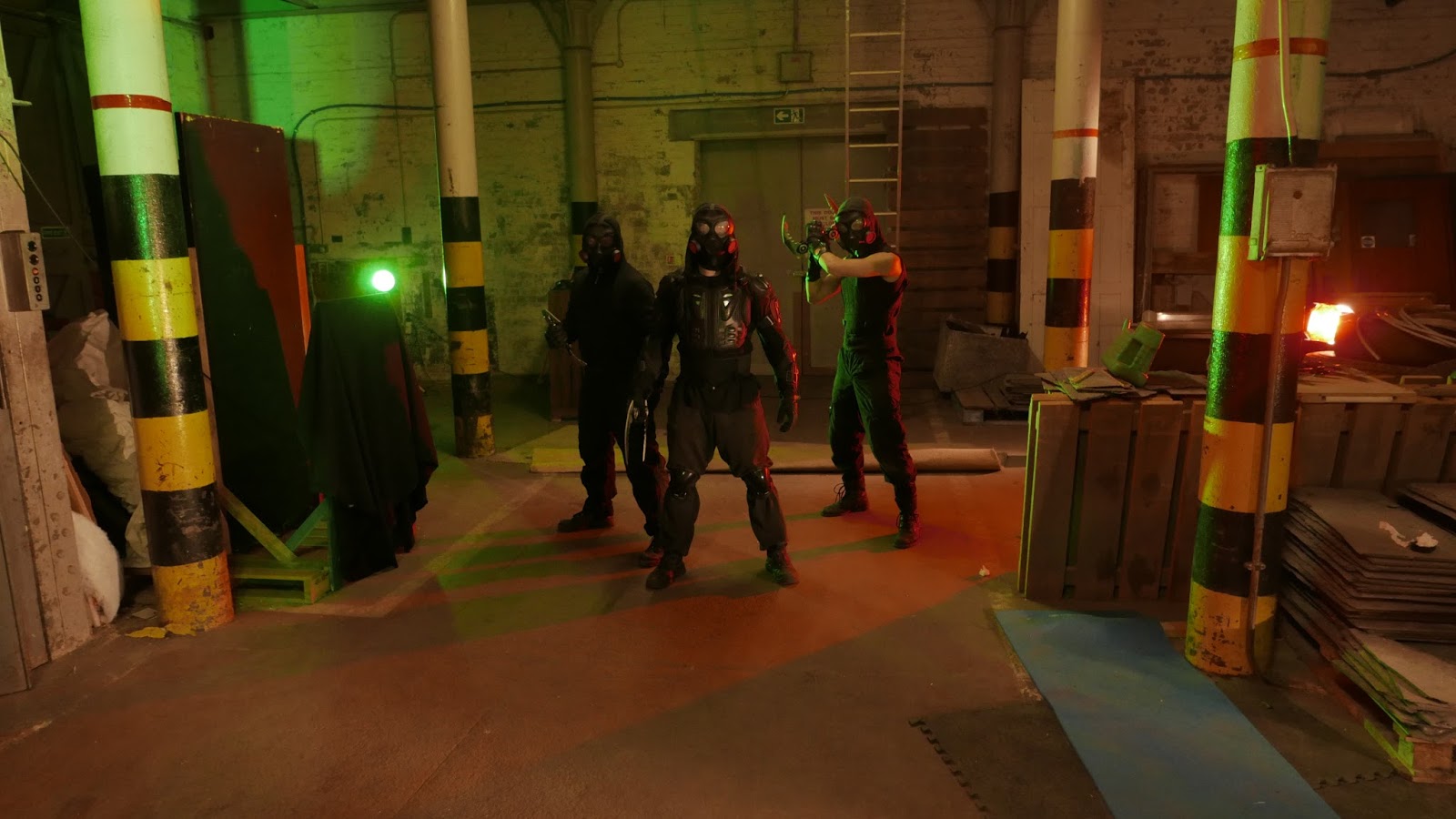
Slasher House 2 (2016) Warehouse 
Slasher House 2 (2016) : Warehouse
For Slasher House 2, we needed a government facility (or something that could pass for one). We actually live in the town that has the government facility that solved the Enigma Code (now a tourist attraction), but they were a flat out 'NO' out of the gate. We decided that we would have to found something that could work instead of and figured a 'Lazer Quest' could work. We emailed every Lazer Quest in a 100 miles radius and out of 25 we got a response from 2, we met with one. It didn't work out due to the times we needed, but we had the location should we want it. 

We eventually went in a different direction that worked out better for us, but I'll talk about that in a future blog. 


___________________________________________________________________

I should point out, that its important to be honest and up front here, telling them you're shooting a family drama when really you're shooting a gore soaked torture porn is counter productive when you turn up on the day and start spraying the place down with food colouring and syrup and if they think they've been fooled, chances of them signing a release form are slim and even if they do and then find out they've been lied to they'll just flat out refuse the next filmmaker that come knocking and its your job to make sure that we pave the way for everybody in the community.

Just like any aspect of filmmaking, employing creative thinking is your friend and if you think about what you need in front of the camera creatively you might even surprise yourself in what you come up with what you think of outside the box or sometimes its as simple as just asking. 

MJ

IF YOU FIND THIS BLOG USEFUL. PLEASE SHARE. You can keep up to date with our filming goings on at our FACEBOOK PAGE :)

 Get Legacy of Thorn on DVD and Digital HD now.
ADVERTISMENT


Monday, 29 February 2016

RAISING THORN : Why I'm Glad my 1st Feature was My 3rd Feature.


4 years ago today I handed over the first draft of a script to my producer and partner Anna, I had been working on it since I was about 15 and on 29th of February 2012 I finally finished it. The date was important, I had set it as a deadline almost four years earlier, because the films story took place on February 29th, it seemed fitting. 

In all honesty I always thought Legacy of Thorn (Known as Thorn then) would be my first low budget feature, but as fate would have it, it was my third. Looking back now at all the delays and mishaps that led to the film taking almost 10 years to get off the ground it all seems like a blessing in disguise. The film happening when it did was great for a lot of reasons, the main one being, that, until that point, I hadn't really been ready to make it.

I had come up with the story when I was pretty young, initially starting life as a Halloween fan film idea of sorts, I quickly went a different direction, taking the elements from my idea that were factual and therefore I could use them with out a law suit (mainly the nordic rune elements that inspired Halloweens later sequels) and then starting with everything else from scratch. Overall it was a pretty simple concept, Kind of Halloween meets The Terminator (Two films which I always felt went hand in hand in terms of tone) but told between two time zones that ran against each other. 

The problem I always had with the traditional 'Slasher' set up, was that they always have a strong opening and then 40 minutes of downtime before they got to the 'good stuff'. The solution I eventually came to was to think of it as two films. One set on February 29th 2008 and one on February 29th 2012, the first playing backwards and the second forward. This way, not only could I break up the downtime, but I could essentially conceal important elements in the story that would feel otherwise mundane. Of course, 15 year old me would have been able to understand any of that. 

So as I tried to get the project off the ground, It never seemed to work quite how I imagined it, over the years I would try and make it work, but at the time didn't have the correct understanding of screenwriting and story structure to do so and so I focused my attention on other things. I was disheartened, because I'd always imagined it would be my first 'proper' feature. Another disguised Blessing.  


Eventually, over 10 years later, after making a butt load of horrible short films and some ok ones, I felt a little more confident that I had the filmmaking tools to make it work. By this time I was in preproduction on my actual first feature 'Creepsville' that I had started to develop with another writer after we graduated. Of course, I still wasn't sure I was ready and so I decided to makes another short film to help us get our heads round using the gear we'd be shooting on. 

I dusted off the old script for short film version of Thorn I'd written (Essentially a scene taken from the bigger movie), another writer friend of mine asked if he could polish it up, and then we shot it in an evening in my friends garage, we put it out there and people dug it, it even won first prize in the Scary or Die competition in 2009 against some pretty amazing entries. It was at that point that I started to feel like 'Thorn' should have been my first feature, and again I felt disheartened. Once again, it was a blessing in disguise. 

Creepsville came and went, It was a tough shoot and that was for a relatively simple concept. We got to the end, but the shoot had been a huge mess, After graduating University a year before, that was still a shoot that I've always considered my 'True Film School'. The film suffered in a lot of ways from my lack of experience. I thought to myself, this could have been 'Thorn', I could have fucked that up, and I felt less disheartened.

In 2009 Post on Creepsville was underway and taking a long time (I was fairly hand offs with it) and rather than sit around waiting I started working on the idea for my next film. "This time" I thought "It's sure to be Thorn". 

Then out of the blue I got wind of two films that were in production that sounded scarily similar to my 2005 feature script 'Slasher House'. I panicked, SH was one of the best ideas I'd ever had (make of that what you will) and it was a pretty low budget screenplay. One location, small cast. I realised it was now or never and I polished up the script and moved the film into preproduction in a bid to 'Get there first'. (Ironically the two film never even went under the lens). 

Thorn ended up on the back burner, but this time it felt a little better. See I had planned for Slasher House to be an ensemble movie and the 4th in a series. Thorn being 1 of 3 leading up to it, The other 2 being Hollower and Cleaver : Killer Clown. This would mean that I would have to change my whole series structure, but the upside was, Thorn played a big part in the Slasher House script. I decided that Slasher House would serve better as an introduction to these characters and we could tell their stories later on. Which we did.


Legacy of Thorn (2014)
Slasher House was shot in 2010/2011 and locked picture in 2012, the day after the Premier I receive dozens of calls and messages asking of there was was going to be a Thorn movie. By the time it came out on DVD in my homeland (The UK) Thorn was already an audience favourite. Now I felt like if there was a time for the Thorn movie, it was now, but whilst making the film, I'd had an inkling this would be the case.

Like I said at the beginning, a few months earlier on February 29th I had handed the first draft of a script to Anna and during this time I had been working on getting the final script ready. The script was HUGE and there was no way that I, as an inexperienced filmmaker, could have made it as a first feature, I mean the finale features a goddam Helicopter for crying out loud. 

The true blessing was that the film allowed itself to be ready before it would allow me to make it and I'm glad it did. Legacy of Thorn is one my proudest filmmaking achievements and had I made it earlier I'm not sure I'd be able to say that.

In February 2013 we started preproduction of Legacy of Thorn and one year later it Premiered in London on February 28th. Of course there was a whole adventure along the way, but that is another story for another Leap Year.


MJ

IF YOU FIND THIS BLOG USEFUL. PLEASE SHARE. You can keep up to date with our filming goings on at our FACEBOOK PAGE :)


 Get Legacy of Thorn on DVD and Digital HD now.
ADVERTISMENT


MYCHO MICROBUDGET MASSACRE MASTERCLASS

ALSO IF YOU'RE BASED IN UK, MICROBUDGET MASSACRE AND THE MILTON KEYNES FILM NETWORK ARE HOSTING THE FIRST OF THIS YEARS SPECIAL 'MYCHO MICROBUDGET MASSACRE MASTERCLASS' LIVE SHOWS ON TUESDAY 8TH MARCH.  


ADVERTISMENT


Wednesday, 30 April 2014

SEEING THE LIGHT : £5 DIY LED lights

MJ Dixon is an Award Winning Filmmaker and Director of Low Budget worldwide releases includingSlasher House and Legacy Of Thorn. He has also seen over 30 music videos and shorts appear on major TV channels around the world as well as running filming workshop The Micro Budget Massacre. He mostly spends his time leaping from life to life, striving to put right what once went wrong and hoping each time that his next leap, will be the leap home.

READ FIRST!! Once again, please understand that this is just my outlook and opinion on aspects of filmmaking, Im not saying its right or wrong, it's just how I do things and how I view things, Filmmaking is about listening to everyone, your peers, professionals and everything in-between. This article is here to be nothing more than helpful to people looking to make movies, hopefully thats you.


The simple fact is, production gear can be expensive. Sometimes really expensive, I lately looked into getting some professional led panels for studio shoot and discovers that to get 2 (in reality I would need at least 3) would cost me well over £1000 . Which as a low budget film producer and video director just doesn't come easy. I also understand that money doesn't grow on trees for those of you just starting out, who want to learn the craft of filmmaking. 

A few years ago I was booked by a band to make a professional music video, It was one of my first as an official company and so I wanted to keep it self sufficient. I didn't have a lot of gear at the time as I was just starting out. The video needed some lights and a black backdrop and through some careful planning I managed to pick that up with the deposit the band gave me. However it left me little money left for the rest of the video.

A lot of the scenes they wanted in thier story element needed to be shot outside on the streets and I couldn't take my newly bought plastering worklights because I couldn't afford a generator at the time to run them. So I knew I needed a portable light of some kind, however anything useable and bright enough was well out of my budget. After wandering around the £1 store one day, I came across the I perfect solution.

I found some ultra bright head torches for £1 each, they ran in AA batteries and were pretty bright, brighter than any other LEDs I go had come across. But not still bright enough. I needed a way to triple the power of them.

 Hollow Demise Video Still. Lit with LEDs in an underpants box. 
At home I had a cardboard window box from some underwear I had had gotten for Christmas. I bought a couple of the lights and realised that they lights slotted in perfectly. I dropped 4 lights in and closed the plastic Perspex of the box top over the lamps and it worked perfectly. Actually, too perfectly, the light was too harsh. A sheet of kitchen roll later and the light was diffused enough to use, Albiet handheld. 

Being made of a cardboard box meant that the light probably didn't have too much shelf life, but it worked in the in the rain for the duration of the shoot. It did however mean that I could reinvent the light to have more longevity. 

So I invented the Tupperlight.


Tupperware tub £1, Bright LED Head Torch £1 x 3, 12 Kodak Batteries £1


Make sure your box fits the lights tight to stop them from moving during use. 


Add A thin sheet on Kitchen roll for Diffusion if needed. 

This is by no means a 'perfect' solution, it has to be hand held for a start (although i'm sure it would be easy enough to mount of a light stand), but it works and is perfect on a low budget. Everything I needed to build this light featured here, I picked up for £4 (+ £1 for 12 low voltage batteries), This one has three lights, which is fine, my original had four, Although you can make a bigger one with a larger casing with as ,many lights as you want. 

No budget Filmmaking is just about being creative with what you have and even though i have since replaced this cheap solution with more reliable lights I still use the Tupperlight every now and then..

You can check out the video that I used it on below. 


MJ

IF YOU FOUND THIS HELPFUL OR HAVE ANY QUESTIONS THEN PLEASE DROP THEM IN THE COMMENTS BELOW. 

Wednesday, 23 April 2014

SEEING THE LIGHT : LEDing The Way

MJ Dixon is an Award Winning Filmmaker and Director of Low Budget worldwide releases including Slasher House and Legacy Of Thorn. He has also seen over 30 music videos and shorts appear on major TV channels around the world as well as running filming workshop The Micro Budget Massacre. He mostly spends his time leaping from life to life, striving to put right what once went wrong and hoping each time that his next leap, will be the leap home.

READ FIRST!! Once again, please understand that this is just my outlook and opinion on aspects of filmmaking, Im not saying its right or wrong, it's just how I do things and how I view things, Filmmaking is about listening to everyone, your peers, professionals and everything in-between. This article is here to be nothing more than helpful to people looking to make movies, hopefully thats you.


CAUTION : Obviously working with any electrics that create heat is dangerous, make sure any lights you get have the required protective glass and caging and of course just like tungsten lights be aware that, if not set up correctly, then it can, like anything on set, be very, very dangerous.

Last week I talked about my standard light set up, using tungsten worklights. Tne set up itself cost very little and is extremely useful and very bright. However it does have draw backs, mainly in regards to how hot these kind of lights get. Although trust me, shooting in the winter in Northern England you'll apprecaite that a little more.

However our set up has evolved over the last few years to include LEDs. LEDs are cooler, lighter and most of the time safer than having lights that intergaret hot glass and Sensetive bulbs. This being a low budget filmmaking blog though, I have a duty to look at the cheapest alternative first and of course that is certainly tungsten worklights. 

The problem with these lights is that they each run at 500w each ( that's just work lights, we're talking 800w upward for pro lights) so if your heading out to location you're suddenly talking, large loud expensive generators and when you are running and gunning, like we have to do 50% of the time, you need something much more reliable and subtle to get the job done.

This is where I employ Led worklights. We picked up 3 of the brightest we could find (I think 108 LEDs) they cost about £50 each and they are rechargable, making them a great portable solution at about a quarter of the cost of 1 professional led panel. They fit to most light stands and last about 3 hours of constant use, so if you are careful with your usage you can get a full nights shooting out of them.

They have some drawbacks like anything, but low budget filmmaking is about jumping over hurdles in order to bring costs down. Now first of all, led lamps are not quite as bright as you would like unless you start moving into spending a few hundred, so most of the time you have to double the light source. These particular lights are rechargable, making them very portable. Downside is that they can't run off the mains without damaging the battery, so they need to be fully charged after they die out, which takes 3 hours. 

Heres an ebay link for the model we use HERE

And just for price comparison heres the same size tungsten (They are about £5 more with a stand) which is twice as bright HERE

Now the simple solution to this, is to have them on charging rotation. But of course that doubles the price of your set up. If your after something to rival the brightness of of a standard tungsten light you'll want to double that again. So we go from a £150 set up to a £600 set up. This however is still about the price of one pro led panel. So it's still a great option on a low budget production and an option I recommend can you afford to shell out a few hundred pounds/bucks on lighting.

However bare this in mind, no lighting solution is the best solution for every situation. Some days LEDs just ain't going to cut it. Sometimes you need something more powerful. We use anything from homemade LEDs to plastering lamps to pro stage lights depending on the job. Knowing what the best tools to use for each job is what will make your films look better, not the fact that you spent $7000 dollar on lighting panels. 

A lot of our pickup outdoor scenes in Legacy Of Thorn had to be quick, All of them were lit using this portable set up and available light and that is really the secret to make LEDs work in large areas. Using them to highlight what is already there. This way you can still have control over what your film looks like, whilst utilising the light around you. Especially if you do your research into the locations lighting ahead of time.

The trick with lighting is understand the strengths and weaknesses of different types of lights, tungsten lights are still cheaper and in my opinion give a warmer, nicer, brighter light despite thier drawbacks. But I certainly can't deny the usefulness of LEDs and I certainly intend to replace my tungsten kit with them eventually, but for the level of light you need on a film set you can be looking at some serious money.

But a few hundred pounds is still a lot of money for low/no budget filmmakers. However there is a slightly cheaper option when it comes to portable LEDs if your willing to put some time in, but I'll talk about that next week ;)

MJ

IF YOU FOUND THIS HELPFUL OR HAVE ANY QUESTIONS THEN PLEASE DROP THEM IN THE COMMENTS BELOW. 


Monday, 24 March 2014

LOCATION, LOCATION, LOCATION : Getting The Most Out Of Your Set

READ THIS** Ok once again, this is just my approach to filmmaking, its not here to cause offence or tell you you're doing it wrong or that i'm doing it right, its just here to share my approach to the process. There is no right way, if this all seems to basic for you then maybe you don't need to read it, or it might serves as a nice refresher for you, it purpose however is to help people who don't know where to begin. But once again this is just how I do things and you don't have to listen to it. 

Locations are extremely important when working on any film. However if you're working on a low budget movie, it can make or break your film. I've lost count of the amount of films I've seen filmed in someone's mom's kitchen, living room, back yard, the field out the back of thier house. I'm not judging, you have to work with what you've got, I mean the sheer amount of movies I shot as a teenager in these kinds of environments is staggering, But it really helped me learn many filmmaking lessons, the most important one being, a good location is everything. 

FINDING LOCATIONS

When I was writing Creepsville, I spend a good few weeks wondering around at night, To judge what the locations would actually look like after dark. It would amaze you the amount of sets I've been on where people have done a recce during the day and then been surprised to find that it was completely unusable after dark. So I waited till the environments were how I would want to use them and then wandered around finding interesting locations to shoot in, places that were well lit or just looked interesting. Then I looked at which of those we could shoot legally (without a permit) and then chose my locations around that. 

For one of the films set pieces I knew that I wanted to use a garage space that they had at the university. I'd used it in my short film Before The Dawn (2006) and it had added incredible production value to my little low budget short and knowing I had access to it in the evenings, I wrote it in. We spent about 4 nights shooting one night inside and then 3 nights on the exterior before our lead took ill for a couple of weeks, knocking us back and behind schedule. 

LOSING LOCATIONS

The Original Garage Scene from Creepsville
About a week later I was wandering past the garage on my way to the University and noticed that the garage looked exteremly light inside. I got closer, only to find that they had completely removed the roof. I was in a panic as we still had about 4 more interior shots to tie the whole inside and outside scenes together. The next day I returned to find that the whole building had just gone, just like that. No warning, no nothing. We couldn't complain, as they had been kind enough to let us use it for free. But we did lose one of the biggest, most expensive looking scenes in the movie. Which was down to some solid acting by two of our actors and of course the huge expansive realism of the location.

The less ideal Reshoot Scene set in House
Luckily one of the most important things about shooting movies is 'Always have a back up', especially when it comes to Locations. We had to re shoot the scene in an abandoned house (which we had looked at for choice when scouting) about a month later, it still worked, but not on the same scale. We also lost our only real stunt sequence in the movie because of it. But more on that another time.

The biggest loss, was that the garage was a working garage during the day, and boy did it look like it. That added so much production value that we just couldn't have put in ourselves building it as a set, there were old fridges, trees cuttings mattresses, two large pick up trucks and oil and dirt everywhere,  it was incredible and it felt, well, real. Because it was.

USING LOCATIONS AS A CHARACTER

EXT. SLASHER HOUSE
INT. SLASHER HOUSE
When we came to shooting Slasher House, we began to struggle finding a building that was run down enough, yet safe enough to let us shoot in throughout the UK. We sat down and started to talk about building the set, as a bunch of interchangeable panels. It wouldn't be ideal and we would lose the realism that I wanted for the film. In my eyes the house had always been a character in the film, an ominous presence and I felt that bulding it on a set would see us lose that. 

Luckily, thanks to our leading man Adam Williams, we found an abandoned prison on the Isle Of Man, who, after a bit of persuasion, allowed us to shoot there for a small price. Of course we had to get our cast and crew out to an isle off the coast of England, but, once again, thats a whole other story. The location was everything I was looking for, it had a character all of its own, that we couldn't have artificially created in a million years. It may have cost us about a third of our budget, but hell, it worth it. 


ADVERTISMENT

DOUBLING UP LOCATIONS

When it came to finding locations for Legacy. Of Thorn, we had to be a bit smarter. It was written around 2 main locations, but in reality was probably about 5 or 6. The trick we had to employ here was finding an existing location that served as a potential production base whilst also bring production value to the film whilst at the same time encompassing all the other locations that we needed throughout the film. A warehouse, a hospital ward, a rooftop and some kind of medium sized cabin. A lot to ask, but essential in making a low budget film like Legacy of Thorn work. Boy did we get lucky.

The school that doubled as Avondale High
Our producer Anna managed to get us into an abandoned school complex that housed all but 2 of our locations. It was kind of incredible and, of course, there's nothing that looks more like a school than a school. However because of the size of the complex the other locations, 'the warehouse', 'the rooftop', 'the abandoned outhouse'. They were all there too and they had all been used and then abandoned, and looked horrible, which made them perfect for our movie. 

The school, we had to clean up, as it needed to look operational, which also included us re flooring the gym, whilst also trying to shoot scenes (not fun for sound). 

But everything else was gritty and dirty and perfect for the look of the movie. If we had tried to turn a set into this kind of thing, we would have been well over budget by the end of it and still would have had nowhere near the realism that we wanted. The warehouse room doubled for the store room with some clever shelf movement, but still leaving us with that used looked we wanted.

The Gym we had to refloor for the Cheerleader Massacre
I think when finding locations when you are on a shoe string budget, you have to try and be efficient. If we have one main location, I always try and make sure that we can also house the cast and crew there if possible. This also saves travel headaches, and keeps your head in the game. It also means that you have your actors with you at all times (as long as they are scheduled to be there for a few days) when it comes to quick retakes or ADR or anything like that. 

I understand that getting a location to shoot your movie seems very obvious, but by being meticulous and getting the right location will change everything about your film. It will add expense and style and most of all it will really help your actors get into scene and character and all of this will improve the final product immensely. Or maybe your film takes place in your mom's kitchen, in which case ignore all of the above.

MJ

IF YOU FIND THIS BLOG USEFUL. PLEASE SHARE. You can keep up to date with our filming goings on at our FACEBOOK PAGE :)


MYCHO MICROBUDGET MASSACRE MASTERCLASS

ALSO IF YOU'RE BASED IN UK, MICROBUDGET MASSACRE AND THE MILTON KEYNES FILM NETWORK ARE HOSTING THE FIRST OF THIS YEARS SPECIAL 'MYCHO MICROBUDGET MASSACRE MASTERCLASS' LIVE SHOWS ON TUESDAY 8TH MARCH.  


 Get Legacy of Thorn on DVD and Digital HD now.
ADVERTISMENT